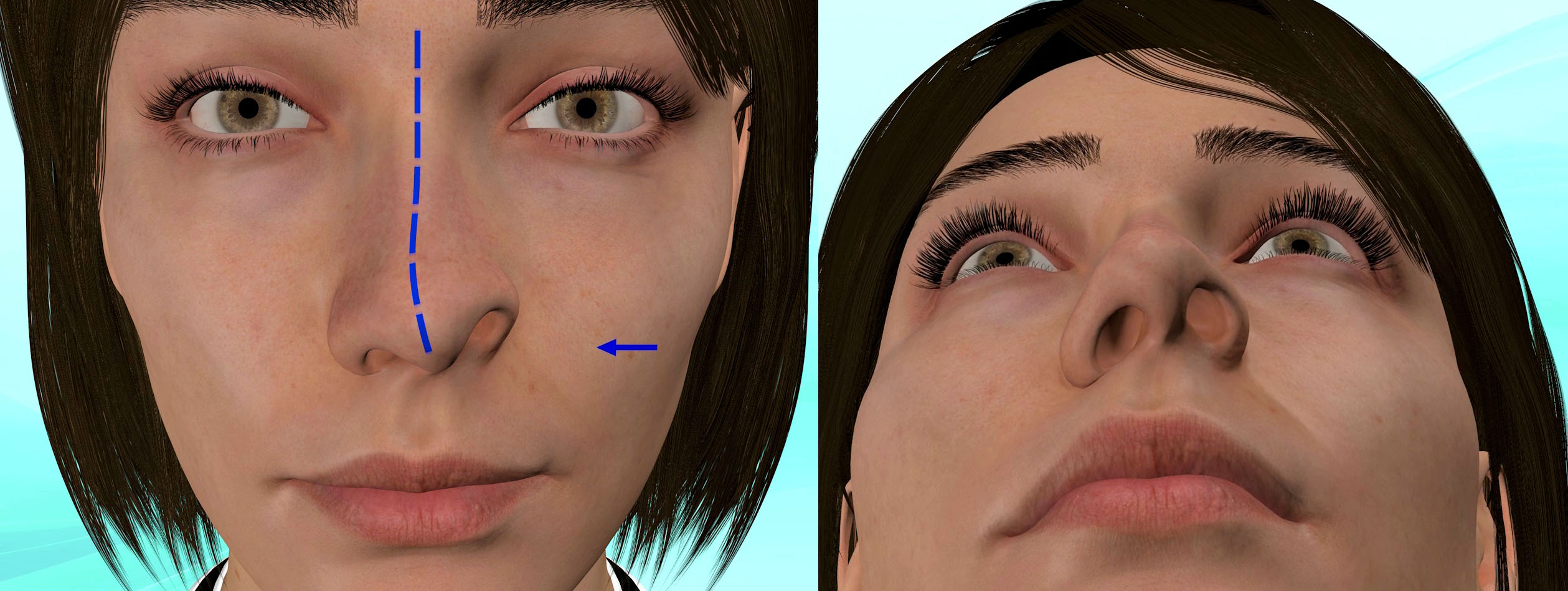
Rhinoplasty with Elastic Suture: Corrects Drooping Noses and Tip Deviations in Multi-Operated Nose (Video1, Video2)
Authors
Keywords:
- Array,
- Array,
- Array,
- Array,
- Array,
- Array,
- Array,
- Array
Abstract
Background: A long nose commonly results from a mismatch between tip support and the downward forces of the long septum, the muscles of facial expression and the depressor septi nasi muscle (which pulls the nasal tip downward). Cartilage laxity, an effect of gravity, also plays a role. Correction of a drooping tip varies with the cause; however, the goal of any traditional corrective technique is to reposition the cartilage to achieve a more cephalic orientation. This simple, economical elastic technique allowed, in selected cases, lifting and straightening of the nasal tip.
Objective: To correct a drooping nasal tip for aesthetic and functional reasons. The study presents the operative possibilities of an elastic suture equipped with a two-tipped needle to lift and straighten the nasal tip, even in noses that have been operated on several times. The study describes elastic rhinoplasty and some possible complementary interventions.
Materials and Methods: After local anesthesia, the surgeon implants an elastic suture with a two-tipped needle (Elasticum EP4 Korpo SRL). The surgeon attaches the elastic thread to the nasal bones through a hole made with a manual shaping drill. The elastic thread encircles the nose, permanently lifting and straightening the tip if it is crooked. Elastic rhinoplasty is often combined with anterior shortening of the septum.
Results: Elastic rhinoplasty was published in 2020 on the Medical Video Journal CRPUB.org. The procedure has been refined in terms of technique, indications and results and the twenty-six patients treated from 2023 to 2026 (19 females, 7 males) were satisfied.
Conclusion: Elastic rhinoplasty, a simple, economical and effective procedure, offers a permanent solution for patients with a long nasal tip, even a crooked one. Its long-lasting results make it a promising option for older patients seeking to improve their breathing and for those who have undergone multiple surgeries.
Downloads
References
Benlier E, Top H, Aygit AC (2006) Management of the long nose: A review of techniques for nasal tip supporting structures. Aesthetic Plat Surg 30: 159-68. https://link.springer.com/article/10.1007/s00266-005-0204-z
Park SG, Jeong H, Ye CH (2014) Multifactorial approaches for correction of the drooping tip of a long nose in East Asians. Arch Plast Surg 41: 630-637. https://www.thieme-connect.de/products/ejournals/abstract/10.5999/aps.2014.41.6.630
Ali S, Bahman G (2009) An algorithm for treatment of the drooping nose. Aesthet Surg J 29: 199-206. https://www.sciencedirect.com/science/article/abs/pii/S1090820X09001009
Capurro S (1984) Un ago a due punte. Rivista Italiana di Chirurgia Plastica 16: 55-58.
Capurro S (2016) Patent: Atraumatic two-point needle for surgical suture. BRPI0610496 (A2): 11-16.
Capurro S (2016) Patent: A traumatic two-point needle for surgical suture. BRPI0610496 (A2): 11-16. https://patents.google.com/patent/WO2006122764A1/en
Capurro S (2020) Elastic rhinoplasty. CRPUB Medical Video Journal. Elastic Plastic Surgery section. https://crpub.org/elastic-plastic-surgery/item/112-46-elastic-rhinoplasty
Wertheim HF, Melles DC, Vos MC, Van Leeuwen W, Van Belkum A, et al. (2005) The role of nasal carriage in staphylococcus aureus infections. Lancet Infect Dis 5: 751-762. C:UsersuserDesktopArticlesSurgery2026JSMCR-26-72 SERGIO OCTlinkinghub.elsevier.comretrievepiiS1473309905702954